Before the Caption: What a Photograph Cannot Tell You
Before the caption, a photograph can show visible details but leave names, causes, dates, and relationships uncertain. Separate what you see from what you infer.
What should you record before a photograph’s caption becomes part of its story? For a photograph without a caption, begin by noting where the image came from and what was attached to it, rather than supplying a name or event from memory. Those small records can preserve clues that later copies tend to shed.
A caption is not merely a sentence beneath an image. It has a history: someone wrote it, at some point, for some purpose, and it may have been revised or copied. Keeping that history visible helps a reader distinguish an original label from a later guess without treating every caption as suspect.
A caption has a source and a history
Photographs often travel with more than one description. An album may have a handwritten note beneath a print; a family member may identify the scene from memory; a website may supply a date and location. These sources can be useful, but they are not interchangeable. A note written on the print is a physical trace of labeling, not automatic proof that its claim is correct.
Record the wording as it appears, including abbreviations, spelling, punctuation, and uncertainty. If a label says “M. by the old mill?” retain the question mark. Rewriting it as “Margaret at the mill” would turn a tentative clue into a confident identification, which is a familiar editorial improvement with an unfortunate side effect.
It also helps to distinguish the person who supplied information from the person who wrote it down. A typed caption may preserve a family member’s account, but the typist and the original speaker have different roles. Note both when that distinction is known.
Keep the photograph and its labels connected
Recordkeeping can be plain. Give each image a stable identifier, then use it on the photograph’s description and on notes about its labels. For a digital collection, a filename or catalog record can serve; for prints, a folder or sleeve can hold a note without writing directly on the image. Keep original materials safe and ask a qualified archivist before changing or marking a valuable object.
For each label, record:
- Exact wording: transcribe what is present; use brackets to mark any text you cannot read.
- Physical location: note whether it appears on the back, in an album, on a sleeve, or in a separate letter.
- Hand or format: record handwriting, typewriting, or a printed label if apparent, without guessing who made it.
- Known source: name the person, collection, or publication that supplied the information.
- Time of labeling: record a date only if the source provides one; otherwise mark it as unknown.
- Relationship to the image: note whether the label is attached to this print, copied from another record, or merely associated with it.
Each field should leave room for an unknown answer. A catalog entry is not improved by filling every blank; a tidy falsehood is still a falsehood, just better organized.
Preserve claims without silently upgrading them
Use wording that shows how a claim is known. “Caption on album page identifies the man as Thomas Reed” reports a source. “Thomas Reed” alone can look like an established identification, especially after the note is separated from its page.
For uncertain details, keep the original claim and add a separate note about its status. For example, “Family note, attributed to L. Ortiz, names the location as Pine Street; not independently confirmed” preserves both the information and its limits. Do not erase an earlier description when a new one appears. Add the newer account with its source and date of receipt so a reader can see that the record changed.
When a label conflicts with another source, retain both versions and describe the disagreement. A photograph’s visual details may help a reader assess a claim, but the record should not quietly decide what the image cannot settle. A caption is more like a luggage tag than a passport: useful for identifying an intended destination, not proof of every stop along the way.
How should you record a caption’s provenance?
Should I transcribe spelling and punctuation exactly?
Yes, preserve the original wording in a transcription, including errors and question marks. If you need a clearer version for readers, add it separately and identify it as an editorial rendering.
What if I do not know who wrote the caption?
Record the label’s location and format, then state that its author is unknown. Do not assign authorship to the person who owns the photograph unless there is evidence for that connection.
Can I add a corrected caption?
Add a new, sourced note rather than replacing the original. Include who supplied the correction and when it was received, so future readers can follow the change.
What should I do if two captions disagree?
Keep both statements with their sources and describe the point of disagreement. If the identification matters for a publication, collection, or family record, consult a knowledgeable archivist or other qualified source before choosing one.
A worked record keeps attribution intact
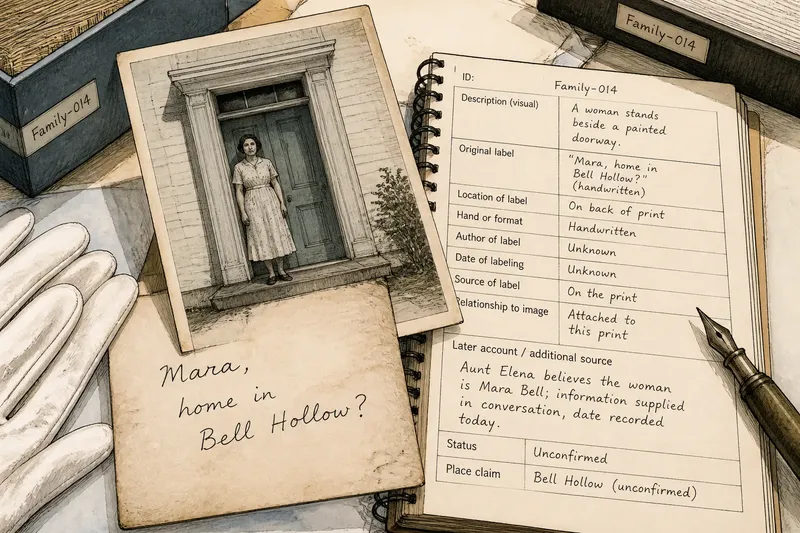
Say you have a loose print showing a woman beside a painted doorway. On its back, a handwritten note reads “Mara, home in Bell Hollow?” Imagine that the note’s writer and date are unknown, and that your aunt later says she thinks the woman was Mara Bell. These are invented details, not a real case.
- Assign the print an identifier, such as “Family-014,” and put that identifier on its protective sleeve and catalog note.
- Transcribe the back exactly: “Mara, home in Bell Hollow?” Record that it is handwritten on the print’s reverse; mark the writer and date unknown.
- Add the later account separately: “Aunt Elena believes the woman is Mara Bell; information supplied in conversation, date recorded today.” Keep her wording as a belief, not a confirmed identification.
- Record the visible description in its own field: “A woman stands beside a painted doorway.” Do not use that description to settle her name or the home’s location.
- Make the catalog decision: identify the person as unknown, retain Bell Hollow as an unconfirmed place claim, and keep both sources attached to the same image record.
The resulting record gives a future reader an original label, a later family recollection, and a clear account of what remains unresolved. If a reliable document later links Mara Bell to the doorway, that can be added as a new source rather than smuggled into the old note.
Check the record before a caption travels
Before sharing a photograph with its description, check each field and choose what to do based on what it contains:
- Image identifier: If the same identifier appears on the image record and its notes, keep them linked; if not, assign one and update both references.
- Exact label: If the original wording is preserved, retain it; if it has been paraphrased, add a verbatim transcription or mark the wording as unavailable.
- Source identity: If the writer or informant is known, name that source; if not, record “unknown” rather than guessing.
- Claim status: If a name, date, or place is confirmed by a documented source, cite that source in the record; if it is only a recollection or inference, label it accordingly.
- Conflicting accounts: If sources agree, preserve their separate attributions; if they disagree, retain both and describe the conflict rather than selecting one without support.
- Changes over time: If a caption has been revised, preserve the earlier wording and add the new version with its source; if no change history exists, note that the revision history is unknown.
Good provenance does not make a caption infallible. It makes the route from photograph to claim easier to inspect. When you record the wording, source, and uncertainty together, the next person can add knowledge without inheriting a guess as though it were part of the frame.