Shadow or Reflection: Two Different Kinds of Trace
Shadow or reflection: learn to read these distinct photographic traces, infer what each can suggest, and avoid mistaking a visual clue for the object itself.
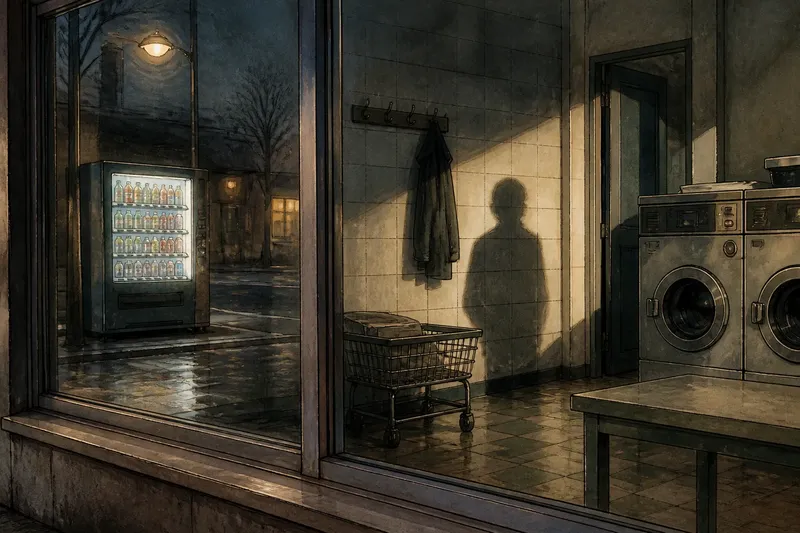
Is the dark shape on the wall a person, or is it only the person’s shadow? In a photograph, that distinction can decide whether a viewer sees a figure, a passing presence, or an unexplained mark. Shadow or reflection: both can suggest that something occupied the scene, but neither is the thing that made it.
Imagine you are photographing a closed neighborhood laundromat after dusk. Through its front window, a bright vending machine reflects in the glass, while a streetlamp throws a long shadow across a tiled wall inside. You can see the shadow’s connection to an unseen body more readily than you can identify the source of the reflection. The picture offers two traces, each with a different relationship to what is absent.
A shadow records an interruption of light
A shadow appears where an object blocks or redirects light. Its shape depends not only on the object, but also on the light source, the surface receiving the shadow, and the position of both. A small object close to a wall can make a crisp outline; a distant or broad light source can soften it. The shadow may stretch, distort, or fall partly outside the frame.
That dependence gives a shadow a useful visual quality: it points outward. A dark contour on a wall can lead the eye toward the place where a body might stand, even if the body itself is excluded. The direction and reach of the shadow provide clues about where light comes from and what may have interrupted it. They do not identify the object with certainty. A coat on a hook, a person, and a sign can cast forms that overlap in a flat image.
In the laundromat scene, the wall shadow angles away from the streetlamp’s direction. Its edge bends around a doorway. Those features make it plausible that an object near the entrance interrupted the light, but the photograph does not disclose whether it was a person, a bag, or something else. The trace is connected to an event of obstruction, not a complete account of the object or its purpose.
A reflection records light returning from a surface
A reflection is formed when light from a scene reaches a reflective surface and travels toward the camera. It may show the surrounding street, a room, or the photographer’s own position. Glass often combines reflected light with whatever lies behind it, so a single patch can carry several visual layers at once.
Unlike a shadow, a reflection usually gives the viewer an image of something on the other side of the reflecting surface, or of something positioned nearby. It can preserve visible detail: a window frame, a vehicle, a bright sign. Yet those details are displaced from their apparent location. A reflection can make an outside object look as though it sits inside a room, especially when the reflected and transmitted views have similar brightness.
The vending machine in the hypothetical laundromat scene appears across the window, laid over the dark interior. Its bright rectangle is easy to read, but its position in the photograph does not prove that the machine is inside the shop. The glass has combined views. The trace offers a visible image of another place, while leaving the camera’s angle and the glass’s surface as part of the evidence.
The two traces make different claims
A shadow is evidence of light being blocked; a reflection is evidence of light returning from a surface. That distinction matters because each trace implies a different kind of relationship. A shadow can suggest an object’s presence through its effect on illumination. A reflection can show an object’s appearance from a displaced viewpoint, but may obscure where that object is in relation to the photographed scene.
Think of the shadow as a mark left when a book interrupts a desk lamp’s beam, and the reflection as the book’s image appearing in a polished tabletop. The first points to what stood between light and surface. The second depends on a surface redirecting an image. The analogy is ordinary, but the photographic results can be less tidy: real scenes layer light, transparent glass, textured walls, and moving subjects.
In the laundromat photograph, the wall shadow may suggest someone near the doorway. The window reflection may suggest a machine on the street. Neither clue should be silently upgraded into a definite statement. A viewer can describe what is visible and what the trace makes plausible without claiming to know what was outside the frame.
Read the scene before naming the source
When a trace is ambiguous, examine its relation to nearby features rather than naming it at once. Look at where it falls, what surface carries it, and whether its edges or orientation connect it to a visible light source or reflective plane. These observations do not solve every mystery; they help separate what the photograph shows from what a viewer supplies.
- Identify the receiving surface. Is the form on a wall, floor, pane of glass, polished metal, or another surface?
- Look for a light source. A shadow’s direction may align with a lamp, window, or low sun, though other light sources can complicate the pattern.
- Check for displaced detail. A reflection may contain recognizable surroundings that do not belong to the apparent depth of the scene.
- Notice edges and overlap. A shadow can merge with a doorway; reflected detail can sit across objects visible through glass.
- Separate observation from inference. “A narrow dark shape crosses the wall” describes the image; “someone is leaving” adds a story.
These checks are not a formula for discovering the hidden object. They are a way to keep the photograph’s visible evidence in view while considering possible sources. If the image is intended as a record, that restraint is part of its accuracy. If it is intended to remain open-ended, the distinction still helps the ambiguity feel deliberate rather than merely confusing.
Framing changes how a trace is read
A trace can become more persuasive when its source is excluded. A shadow cut off by the picture edge may seem to continue beyond the frame, inviting the viewer to imagine a body just outside it. Include the body, and the same shadow may become a secondary detail. The object has not changed; the photograph’s distribution of attention has.
Reflections are equally sensitive to framing. A slight change in camera position can move a reflected sign across a window or remove the photographer’s own reflection. In a photograph, those shifts can make a reflection appear to belong to a different plane. The viewer may read it as an object behind the glass, a mark on the glass, or an image from the street.
For the invented scene, suppose you move a step to the left before making another frame. The vending machine’s reflection slides toward the window frame, while the wall shadow remains in nearly the same place. The second image makes the reflection’s connection to the pane easier to notice, while the shadow still points toward an unseen source. That change is not proof of what cast the shadow; it is a useful comparison between two ways of looking.
What can a shadow or reflection tell a viewer?
Does a shadow prove that a person was present?
No. It can suggest that an object interrupted light, but the photograph may not show whether that object was a person or something else. Describe the visible shape before assigning it an identity.
Can a reflection show what is behind the camera?
It can include a view from the camera’s side of a reflective surface, depending on the angle and light. The reflection may be incomplete or mixed with the view through the glass, so its contents do not necessarily establish a precise location.
Why does a reflection seem to sit inside a photograph’s scene?
Reflected light is recorded alongside light passing through or around the surface. Similar tones and overlapping edges can flatten the distinction between those layers, making outside detail appear to occupy the same space as the interior.
How should an ambiguous trace be captioned?
State what is plainly visible, then mark interpretation as interpretation. A caption can say that a shadow crosses the wall without calling it a departing figure unless other context supports that description.
Let the trace remain a trace
In the imagined laundromat photograph, the result is not a solved scene. The shadow makes an unseen obstruction legible; the reflection brings a displaced view onto the window. The first suggests presence through absence of light, while the second suggests presence through an image returned from glass. Their differences give the viewer useful clues without supplying a complete story.
When reading or making photographs, shadow or reflection is a distinction worth preserving. Name the surface, follow the visible light, and keep the source separate from its mark. A trace can carry real visual information while leaving its cause unresolved. That is not a failure of the photograph; it is a boundary the viewer can see.